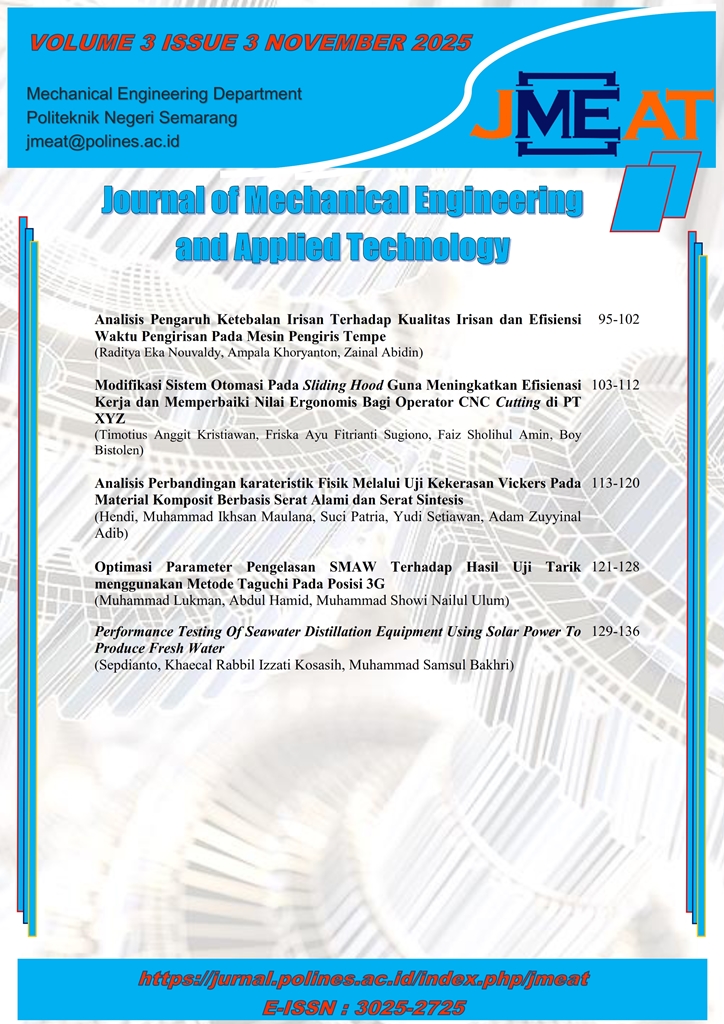
ANALISIS PENGARUH KETEBALAN IRISAN TERHADAP KUALITAS IRISAN DAN EFISIENSI WAKTU PENGIRISAN PADA MESIN PENGIRIS TEMPE
DOI:
https://doi.org/10.32497/jmeat.v3i3.7206Abstract
The tempe processing industry plays a strategic role in food security and the local economy, especially within small and medium enterprises. However, productivity challenges remain, particularly in the slicing process, which impacts the quality and efficiency of production. This study investigates the effect of tempe slice thickness variation (2 mm, 3 mm, and 4 mm) on slice quality (categorized as intact and damaged) and slicing time using a specific performance cutting machine. It addresses the research gap where previous studies have not optimized the relationship between slice thickness and the drive motor performance of tempe cutting machines. The objective is to analyze the influence of slice thickness on quality, time efficiency, and motor performance. An experimental method was employed, varying slice thickness and measuring slice quality and cutting time using quantitative data analyzed descriptively and comparatively. Results showed a significant impact of slice thickness on both quality and time efficiency; 4 mm slices yielded the best quality with the highest intact slice percentage, whereas 2 mm slices resulted in the shortest cutting time. In conclusion, optimizing slice thickness and motor performance is essential to produce high-quality tempe slices with maximum time efficiency. These findings are significant for developing tempe slicing machine technology that enhances productivity and competitiveness for MSMEs.
Downloads
Published
How to Cite
Issue
Section
License

This work is licensed under a Creative Commons Attribution-NonCommercial-ShareAlike 4.0 International License.
Copyright of articles that appear in Journal of Mechanical Engineering and Applied Technology belongs exclusively to Penerbit Jurusan Teknik Mesin Politeknik Negeri Semarang. This copyright covers the rights to reproduce the article, including reprints, electronic reproductions, or any other reproductions of similar nature.