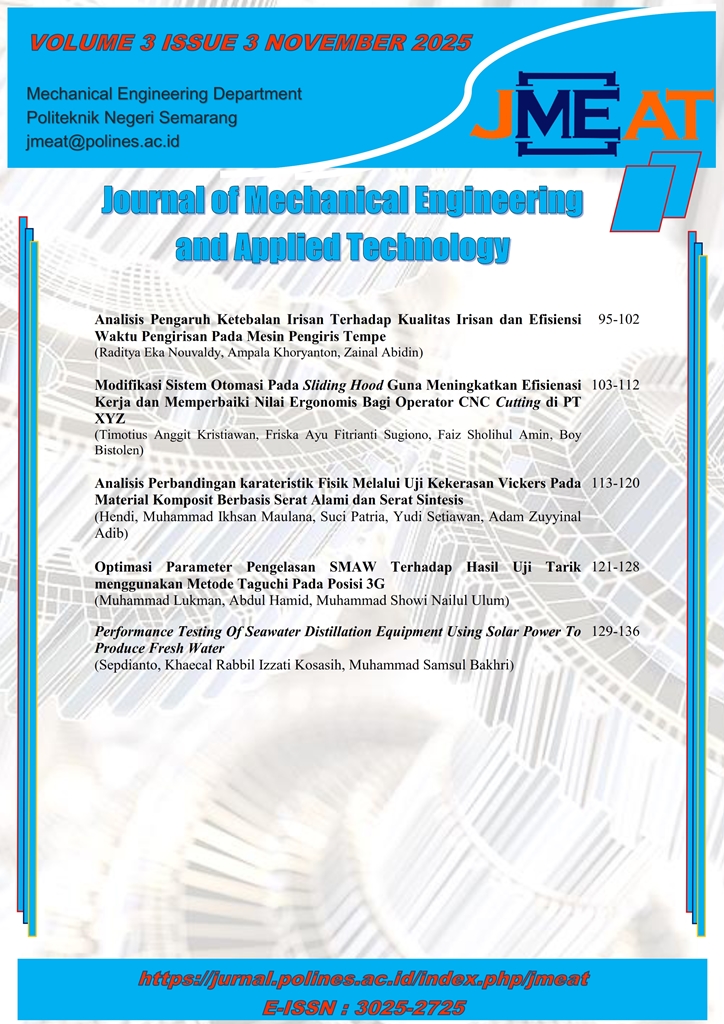
PERFORMANCE TESTING OF SEAWATER DISTILLATION EQUIPMENT USING SOLAR POWER TO PRODUCE FRESH WATER
DOI:
https://doi.org/10.32497/jmeat.v3i3.7195Abstract
Design is a stage that involves several systematic stages, ranging from basic calculations to the performance test process. In the process of making distillation equipment, after the fabrication process, a process of testing the performance of the tool is required. Where is the performance test process to find out if the tool is in accordance with the calculations made in the previous process. This study aims to determine the quality of water resulting from distillation which includes, TDS, odor, pH, and salinity. The test method used in this study is experimental by conducting a performance test of a distillation device that utilizes sunlight for 5 days with 5 liters of water tested (1 liter per day continuously) starting from 08.00 to 17.00 by making observations every 1 hour. The results of the equipment test show that the quality of the water produced from the distillation equipment has met the standards of the Indonesian Ministry of Health. No.2 of 2023, while for the highest freshwater productivity per day of 287 ml and the lowest 204 and for the highest distillation equipment performance with an efficiency value of 94.18% and
the lowest efficiency of 86.75%.
Keywords: Distillation; Solar Power; Sea Water; Quality
Downloads
Published
How to Cite
Issue
Section
License

This work is licensed under a Creative Commons Attribution-NonCommercial-ShareAlike 4.0 International License.
Copyright of articles that appear in Journal of Mechanical Engineering and Applied Technology belongs exclusively to Penerbit Jurusan Teknik Mesin Politeknik Negeri Semarang. This copyright covers the rights to reproduce the article, including reprints, electronic reproductions, or any other reproductions of similar nature.