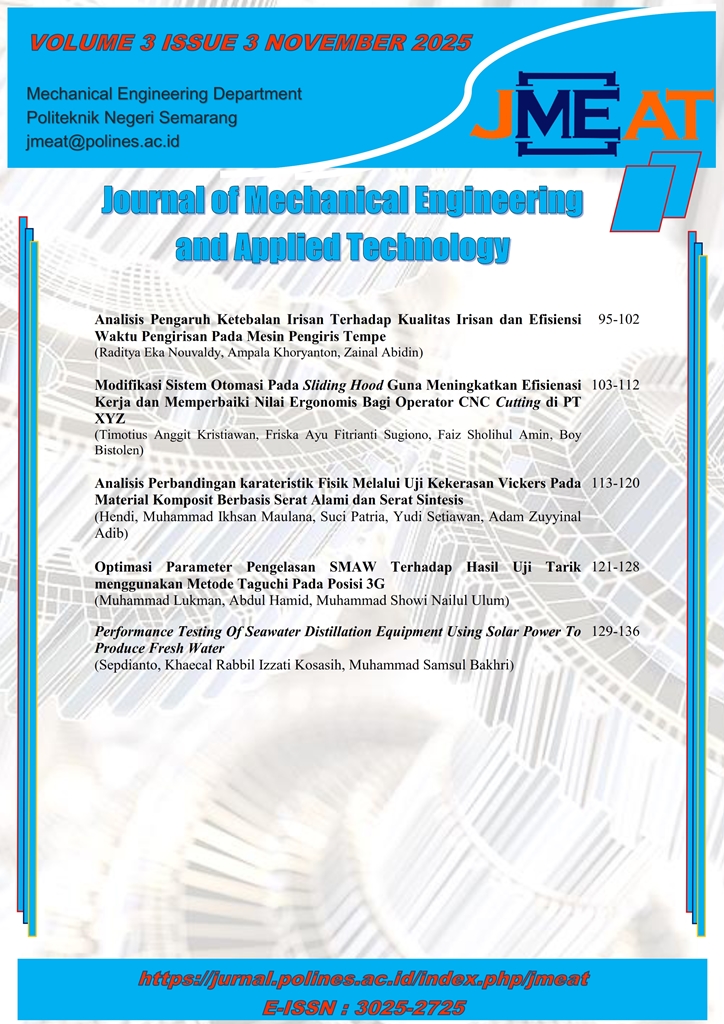
ANALISIS PERBANDINGAN KARAKTERISTIK FISIK MELALUI UJI KEKERASAN VICKERS PADA MATERIAL KOMPOSIT BERBASIS SERAT ALAMI DAN SERAT SINTETIS
DOI:
https://doi.org/10.32497/jmeat.v3i3.7158Abstract
Composite materials have become highly important in the manufacturing industry. However, the development of composites often faces the challenge of finding effective, economical, and environmentally friendly reinforcing materials. This study aims to analyze the comparison of physical characteristics in composite materials reinforced with natural fibers through Vickers hardness testing and then compare these hardness values with composite materials reinforced with synthetic fibers. The Vickers hardness testing method adheres to the ASTM E348 microhardness testing standard. The results show that the addition of fibers to composite materials tends to increase the likelihood of voids or trapped air bubbles within the composite material, which increases its porosity value. Furthermore, the use of synthetic fibers, especially carbon fiber, is still superior to pineapple leaf fiber (PALF) because the hardness value of carbon fiber is indeed superior to other fibers. However, pineapple leaf fiber (PALF) has advantages in its stability, is more environmentally friendly, and has a lower production cost compared to synthetic fibers.
Downloads
Published
How to Cite
Issue
Section
License

This work is licensed under a Creative Commons Attribution-NonCommercial-ShareAlike 4.0 International License.
Copyright of articles that appear in Journal of Mechanical Engineering and Applied Technology belongs exclusively to Penerbit Jurusan Teknik Mesin Politeknik Negeri Semarang. This copyright covers the rights to reproduce the article, including reprints, electronic reproductions, or any other reproductions of similar nature.